
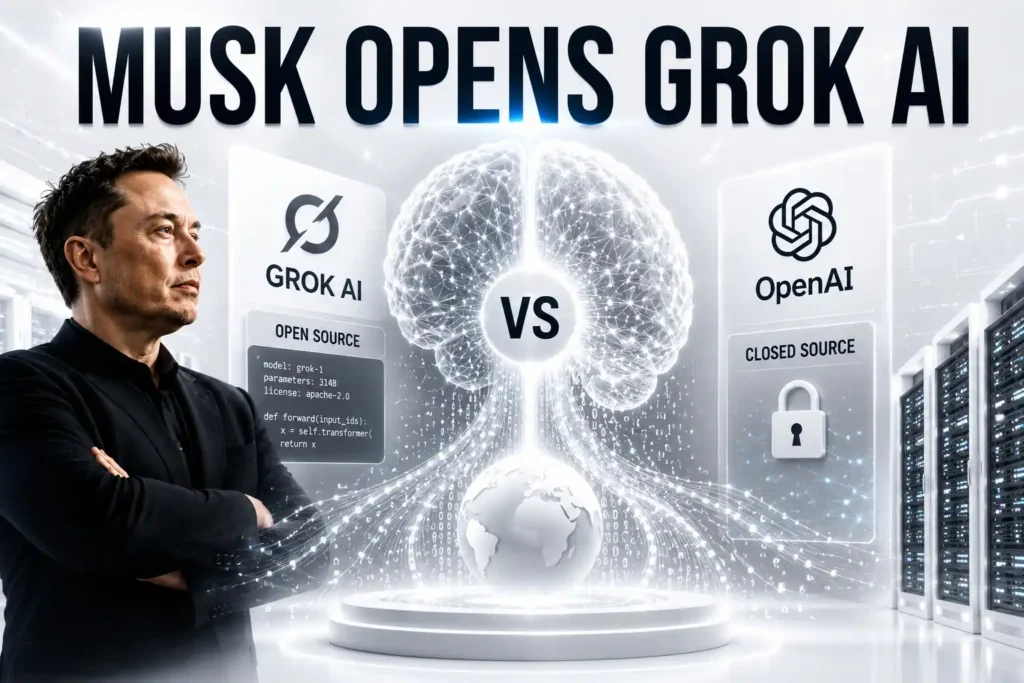
The battle for supremacy in the artificial intelligence landscape has taken an aggressive turn. Elon Musk, the tech billionaire and founder of xAI, has officially announced that his company will open-source its flagship AI chatbot, Grok. This strategic move is designed to make advanced AI technology highly accessible to developers, researchers, and enterprises worldwide, while fundamentally disrupting the current market dynamics.
Musk’s decision directly intensifies his ongoing feud with OpenAI, a company he co-founded in 2015 but has since heavily criticized for transitioning from a non-profit research lab into a commercial, closed-source giant. By making Grok open-source, Musk aims to champion transparency in AI development and deliver on his vision of creating technology that genuinely benefits humanity.
The Core Timeline: From Launch to Open-Source of Grok Chatbot
To understand how Grok reached this milestone, here is a breakdown of xAI’s rapid development cycle and its transition to an open-access model:
| Timeline / Phase | Event & Key Development Details |
| July 2023 | Elon Musk officially launches xAI to compete with OpenAI and Google. |
| November 2023 | Grok-1 is released to Premium+ subscribers on X (formerly Twitter) after just 4 months of training. |
| November 2023 | Musk expresses his strong bias toward open-source AI during a podcast with Lex Fridman. |
| March 2024 | Musk officially announces on X: “This week, @xAI will open source Grok.” |
| Post-Release Impact | The base weights and architecture of the 314-billion parameter Grok-1 model are made publicly available. |
Why Open-Sourcing Grok is a Game-Changer
Open-sourcing a massive LLM (Large Language Model) like Grok isn’t just a publicity stunt; it carries profound technical and philosophical benefits. Here are the most critical impacts of this decision:
- Unprecedented Scale Available to All: With 314 billion parameters, Grok-1 became the largest completely open-source language model available at the time of its release, easily dwarfing competitors like Meta’s LLaMA 2 in raw architecture scale.
- Complete Flexibility for Enterprises: Instead of relying on a closed API (like ChatGPT) and waiting for internal corporate teams to fix bugs or update features, developers can modify Grok’s source code directly to suit specific business needs.
- Real-Time Data Integration: Unlike standard models trained on static datasets, Grok is uniquely engineered to access real-time information via the X platform, giving it a distinct edge in analyzing current global events.
- A True Alternative to “Closed” AI: It provides an immediate, powerful alternative for researchers who are deeply skeptical of black-box AI models and demand total transparency in algorithmic training weights and safety parameters.
Also read : Indian Railways AI chatbot: This new AI tool can help you book train tickets.
“OpenAI is a Lie”: The Escalating Musk vs. Altman Feud
The decision to open-source Grok is deeply personal for Musk. He has repeatedly accused OpenAI of deviating completely from its original foundational charter. When an X user suggested that OpenAI should follow xAI’s lead if they truly want to live up to the “Open” in their name, Musk responded bluntly: “OpenAI is a lie.”
This ideological war has triggered a series of highly publicized corporate roasts and legal actions:
- The “4-Month” Jab: When xAI initially launched Grok after four months of development, OpenAI CEO Sam Altman publicly mocked it by posting a screenshot showing how he recreated a basic version of Grok using a single prompt in OpenAI’s custom GPT Builder.
- The Submarine Comeback: Infuriated by the dismissal of his engineering team’s hard work, Musk fired back on X, stating, “GPT-4 is about as funny as a screendoor on a submarine.”
- The Legal Battle: Beyond social media banter, Musk escalated the conflict by filing a formal lawsuit against OpenAI and Sam Altman, alleging a breach of contract and demanding that the company return to its open-source, humanitarian roots.
What This Means for the Future of AI
By opening up Grok to the public, Elon Musk is forcing the tech industry to choose a side: a tightly controlled, commercialized ecosystem controlled by a few massive tech monopolies, or a decentralized, transparent community driven by open-source collaboration.
While closed-source giants like OpenAI and Google still maintain a massive market share, xAI’s decision to hand over the keys of a multi-billion parameter model to global developers shifts the balance of power. It democratizes AI development, ensures higher algorithmic accountability, and proves that xAI is ready to completely reshape how humanity interacts with artificial intelligence.