


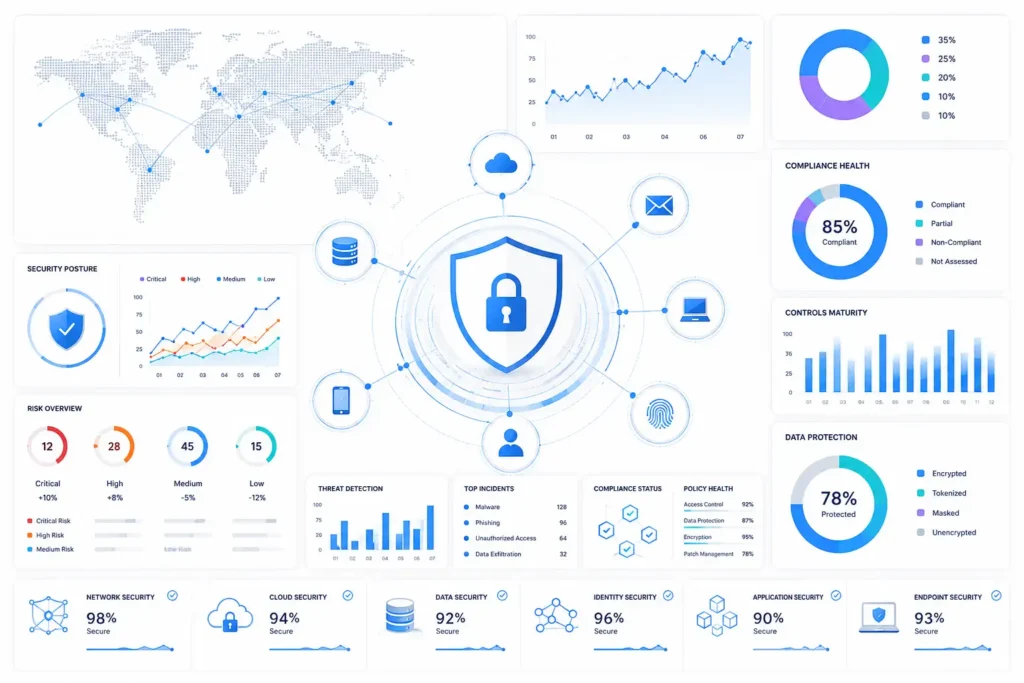
The corporate landscape is facing a regulatory storm. For modern enterprises, managing cybersecurity risk exposure while maintaining compliance with overlapping legal frameworks has turned into a high-stakes operational puzzle. The rapid expansion and enforcement of stringent mandates-such as NIS2 (Network and Information Security Directive), DORA (Digital Operational Resilience Act), and GDPR (General Data Protection Regulation)-have fundamentally rewritten the rules of corporate responsibility.
Unfortunately, many enterprises are still playing catch-up. They treat security and regulatory compliance as separate, parallel tracks. This fragmented methodology relies on reactive, siloed workflows that fail to turn raw risk data into actionable defensive intelligence. To survive an increasingly sophisticated threat environment, forward-thinking organizations must ditch piecemeal, checkbox security in favor of an integrated, governance-driven cybersecurity framework.
The Fatal Flaw of “Piecemeal” Cybersecurity
Against a backdrop of AI-driven phishing campaigns, systemic supply chain vulnerabilities, and aggressive ransomware networks, a piecemeal approach to cybersecurity is a liability. Historically, companies have built defensive walls by stacking disconnected point-solutions: a firewall here, an endpoint detection tool there, and an annual external audit to satisfy regulators.
This fragmented setup creates deep operational blind spots. The hard truth of modern enterprise infrastructure is simple: compliance does not automatically equal security.
When these functions operate in isolation, several systemic failure points emerge:
- The Security Coverage Gap: An enterprise can pass an IT compliance audit with a perfect score and still suffer a catastrophic data breach. This happens because rigid compliance checklists are static, whereas live technical threats are dynamic and constantly mutating.
- The Reactive Audit Scramble: Without a long-term governance strategy, organizations spend excessive capital and engineering hours scrambling to meet sudden regulatory deadlines. This leads to panic-buying of software and the chronic misallocation of defensive resources.
- The Communication Chasm: Organizations routinely separate their GRC (Governance, Risk, and Compliance) departments from their active SecOps (Security Operations) teams. Because these teams speak different operational languages, SecOps struggles to tie daily network alerts back to legal compliance obligations, and GRC fails to see how active vulnerabilities impact corporate risk thresholds.
Also read : Apple Reveals iOS 27 Features: AI Voice Control, Smart Accessibility and Vision Pro Upgrades
Blueprint for an Integrated Governance & Assurance Strategy
A modern cybersecurity posture requires embedding GRC principles directly into the technical fabric of daily security operations. Rather than treating compliance as a passive chore performed for regulators, it must become a continuous reflection of the company’s real-time security state.
| Core Pillar | Operational Flow & Functional Role | Business Impact & Strategic Value |
| 1. Threat Intelligence | Feeds Real-Time Threat Context: Continuously monitors external global threat vectors, hacker behaviors, and zero-day vulnerabilities. | Proactive Defense: Allows the enterprise to anticipate attack methods before they impact internal infrastructure. |
| 2. Security Operations | Maps Active Vulnerabilities & Logs: Actively scans local network endpoints, cloud configurations, and system logs to identify open weaknesses. | Real-Time Detection: Connects external threat data directly to internal infrastructure realities. |
| 3. Continuous Monitoring | Verifies Controls & Flags Deviations: Automatically and perpetually tests defensive security controls to catch any security posture drift. | Zero Blind Spots: Eliminates the vulnerability windows traditionally left open between annual manual audits. |
| 4. Governance & GRC | Translates Data into Executive Decisions: Aggregates all technical security telemetry into high-level risk and compliance metrics. | Strategic Resilience: Empowers CISOs and board members to make fast, data-driven financial and legal choices. |
1. Centralized and Integrated Risk Visibility
Instead of running isolated risk assessment exercises across disparate business units, enterprises need a unified data lake. Consolidating metrics from internal penetration tests, external vendor audits, and cloud configuration logs allows executive leadership to see exactly where compliance obligations overlap with active security gaps.
2. Continuous Compliance Monitoring vs. Periodic Audits
The traditional model of relying on quarterly or annual point-in-time assessments is dangerously obsolete. In a continuous monitoring framework, automated testing tools constantly verify that security controls are active and functioning. This dramatically reduces the “vulnerability window”-the dangerous time gap between official audits where configurations drift and systems become exposed.

3. Threat Intelligence-Driven Risk Management
True assurance means moving away from a purely reactive defense. By feeding real-time global threat intelligence directly into the internal governance model, security teams can anticipate upcoming attack vectors. Resources can then be proactively directed to reinforce compliance controls before a specific exploit targeting their industry becomes widespread.
Demanding Accountability: NIS2 and DORA as Catalyst
The push toward integrated governance is no longer just a theoretical best practice—it is being legally mandated by governments worldwide. Modern regulatory frameworks are changing the game by focusing heavily on executive accountability and operational uptime:
- DORA (Digital Operational Resilience Act): Specifically targeting the financial sector, DORA mandates that institutions must prove they can withstand, respond to, and recover from severe ICT-related disruptions. It moves the conversation completely past simple data privacy and forces companies to map out cross-departmental operational resilience.
- NIS2 Directive: Expanding drastically across critical infrastructure sectors, NIS2 introduces strict reporting timelines (often requiring an initial notification within 24 hours of a breach) and explicitly holds top-tier management personally liable for cybersecurity negligence.
Hoping to survive these rigid legal landscapes without a centralized, automated risk-based governance model is an unsustainable corporate strategy.
Transforming Compliance into a Strategic Advantage
When executed correctly, an integrated governance and assurance model transforms compliance from an expensive regulatory burden into a powerful strategic business enabler.
By mapping technical security controls directly to your compliance matrix, your enterprise gains structural business advantages:
- Streamlined, Cost-Effective Reporting: Integrating artificial intelligence (AI) and machine learning algorithms can automate the collection of audit evidence. This dramatically reduces human error and eliminates the manual, resource-draining labor traditionally required to prepare for data protection authorities.
- Synchronized Business Continuity: Incident response, disaster recovery, and data protection strategies remain completely aligned with legal mandates. If a cyberattack occurs, the organization can contain the threat and issue legal disclosures seamlessly, minimizing both operational downtime and secondary legal penalties.
- Data-Driven Executive Decisions: Armed with unified risk and compliance dashboards, Chief Information Security Officers (CISOs) can present clear, quantified financial risk data to the board of directors, ensuring faster budget approvals for critical security infrastructure.
The Path to Total Operational Resilience
The evolutionary trajectory of cybersecurity challenges will not slow down. Organizations must urgently adapt by shifting their focus away from archaic, compliance-centric checklists and toward integrated, governance-driven cybersecurity architectures.
The future of digital corporate security belongs exclusively to enterprises that successfully unify threat intelligence, data risk management, and regulatory compliance into a single, proactive operational loop. Companies that choose to ignore this evolution will continue to face massive security gaps, devastating regulatory fines, and irreparable reputational ruin. Adopting a holistic GRC-driven strategy is the only path forward to achieve true, long-term operational resilience.