

The smartphone craze and digital lending market in India have grown exponentially over the last few years. Today, almost anyone can easily purchase a premium or flagship device using attractive no-cost EMI options. However, this ease of access has birthed a massive headache for banks and NBFCs (Non-Banking Financial Companies): loan recovery. A rising number of borrowers are defaulting on their monthly installments, causing a sharp spike in bad loans within the consumer durable segment.
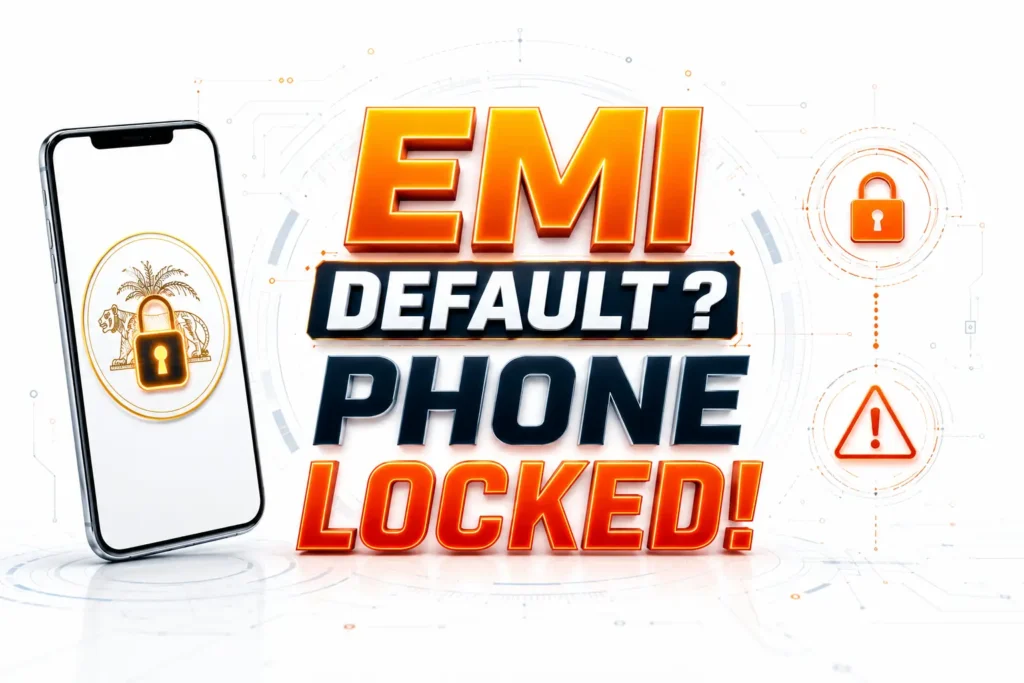
To tackle this specific issue with a tech-driven solution, the Reserve Bank of India (RBI) has proposed a groundbreaking draft framework. Under this new policy, if a borrower consistently defaults on their smartphone EMI, lenders could be authorized to disable specific features of the handset remotely.
Crucial Note : This regulation is currently in its draft stage. It is an official proposal open for stakeholder feedback and has not yet been implemented as a legally binding law.
Quick Summary
- Current Status: Proposed draft stage; not yet implemented as an active law.
- The Timeline: A hard lock or feature restriction triggers only after 90 consecutive days of EMI default.
- Consumer Safeguards: Emergency calls, incoming calls, and critical government alerts will never be blocked.
- Scope of Rule: Applicable exclusively to devices purchased via dedicated mobile/consumer durable finance schemes.
- The Controversy: Tech experts and privacy advocates are raising major flags regarding user data security and the “Right to Privacy.”
Understanding the RBI Phone EMI Rule: A Deep Dive
According to the RBI’s draft proposal, if a consumer stops paying their smartphone EMIs, lenders will be legally permitted to deploy Device Restriction Technology. This software mechanism operates deep within the operating system (OS) layer of your mobile device, allowing financial institutions to restrict access to the phone’s ecosystem remotely.
What’s Covered (and What’s Exempt) ?
It is vital to understand that this upcoming structural rule distinguishes between how a loan is sourced:
- Device Finance (Covered): The rule applies strictly if you financed the specific device directly through a mobile loan or consumer durable loan where the phone acts as the underlying security.
- Personal/Home Loans (Exempt): If you purchased a premium device using a general personal loan or an overdraft facility, lenders cannot lock your device. In those scenarios, the debt is tied directly to your financial profile and bank account, not to the hardware IMEI itself.
The Concept of ‘Digital Collateral’ (Why RBI is Stepping In)
Integrating such a hardline remote software lock into the banking ecosystem comes down to two major economic and practical justifications:
1. The Digital Collateralization Framework
In traditional banking, loans are backed by physical security – such as gold, property, or vehicles. However, a customer looking to finance a Rs. 10,000 or Rs. 20,000 smartphone cannot be expected to pledge physical gold or land. Because the handset itself lacks traditional physical collateral security weight, the RBI proposes using software access control as digital collateral. Effectively, your uninterrupted right to use the device becomes the bank’s security deposit.
More Read

2. High Cost of Micro-Loan Recovery
Recovering low-ticket micro-loans is one of the most expensive operational challenges for lenders. If a borrower defaults on a small amount, deploying physical recovery agents or initiating formal legal proceedings often costs the bank significantly more than the outstanding loan balance itself. To fix this structural deficit, lenders requested a remote digital enforcement mechanism from the central bank to exert pressure on defaulters without incurring field recovery expenses.
Recovery Process & Timeline: When Does the Phone Actually Lock ?
Lenders cannot simply freeze your smartphone the morning after a single EMI bounce. The RBI has laid out a transparent, multi-stage timeline designed to give borrowers adequate time to correct their financial shortfalls. A total buffer window of 90 days is mandated before extreme steps are taken. The step-by-step enforcement sequence is broken down in the table below:
RBI Phone EMI Rule Enforcement Timeline
| Stage | Expected Timeline | Device Status | Process Details |
| Digital Consent | At the time of purchase | Fully Functional | The borrower must explicitly agree to the device restriction terms within the loan agreement. |
| First Official Notice | 60 days post-default | Fully Functional | Triggered after two consecutive missed EMIs; the lender sends official warnings and payment links. |
| Second Notice Period | Next 21 days | Fully Functional | A critical warning phase informing the user about impending software restrictions. |
| Final Grace Period | Last 7 days of the window | Fully Functional | The final ultimatum before remote software block mechanisms are greenlit. |
| Account NPA & Lock | Post 90 Days Total | Selective Feature Block | The loan transitions into a Non-Performing Asset (NPA). Device restriction mode goes active. |
Also Read this : Apple Reveals iOS 27 Features: AI Voice Control, Smart Accessibility and Vision Pro Upgrades
User Safety: What Features Will Remain Active ?
The RBI draft balances lender recovery rights with a borrower’s basic human and emergency requirements. Financial platforms are strictly prohibited from completely turning off or bricking a smartphone. Even during an active device restriction lock, the following essential life-saving services will remain permanently functional:
- Emergency Calls: Unrestricted access to dial emergency services (like 112, 100, or medical helplines) will remain open.
- Incoming Communications: All incoming phone calls remain completely active, ensuring family members or bank representatives can maintain contact with you.
- Government and Disaster Alerts: Public safety broadcasts, extreme weather notifications, or official government SMS dispatches will bypass any software lock.
What Can Lenders Actually Block ?
Lenders can selectively restrict commercial, social media, and entertainment apps. For instance, they can disable access to platforms like WhatsApp, Facebook, YouTube, or Netflix, lock down open web-browsing capabilities, and temporarily cut off standard outgoing voice calls.
Privacy Paradox: Data Safety & Constitutional Red Flags
The loudest pushback against this proposed EMI default framework focuses on consumer privacy. For a lender’s application to control and limit OS features remotely, it requires deep system-level or root-level permissions.
The Big Question : Can lending applications exploit these administrative privileges to scrape personal photos, monitor private chat logs, read emails, or export contact lists ?
The Supreme Court of India’s landmark K.S. Puttaswamy judgment firmly established that the Right to Privacy is a fundamental right under Article 21 of the Constitution. If fintech platforms abuse these system permissions to access or backup personal telemetry data, it represents a severe constitutional breach. Consequently, cybersecurity professionals are demanding that the RBI establish bulletproof, zero-trust data firewalls before finalizing this draft into an enforceable law.
Also Read : Google I/O 2026: Gemini 3.5, AI Agents and Smart Glasses Steal the Spotlight
Financial Inclusion and Market Projections
Provided that data security regulations remain uncompromised and strict misuse penalties are instituted, this framework could deliver noticeable macroeconomic benefits to the Indian banking ecosystem:
- Boosting Financial Inclusion: When lenders have a technical guarantee of asset recovery, they will be far more confident underwriting loans for individuals with thin credit files or subprime CIBIL scores. This expands formal credit access across Tier-2, Tier-3 towns, and rural sectors.
- Lowering Interest Rates: Efficient digital recovery pipelines naturally compress a bank’s Non-Performing Asset (NPA) percentages. As risk premiums drop across consumer durable portfolios, lending institutions can pass those savings down to the consumer in the form of lower processing fees and cheaper interest rates.
- A Global Regulatory Standard: While pay-as-you-go asset locking infrastructure exists in developing economies like Kenya or Nigeria for localized utilities, India is set to become the first major global economy to regulate this technical framework directly via a centralized banking authority.
While the RBI’s draft policy promises to streamline asset recovery operations and protect banking institutions from bad debts, it treads on a thin line regarding consumer data confidentiality. Mitigating the security risks associated with device-level administrative control demands clear data isolation policies to prevent unauthorized data collection. Because this system is currently sitting on the draft table, expect several iterative legal and technical revisions before it goes live across retail sectors.
FAQ: Frequently Asked Questions
Q: Will my phone immediately shut down if I miss a single EMI payment ?
A: No. Under the proposed RBI draft guidelines, you will receive a series of formal notices and grace windows stretching across a total 90-day (3-month) corrective period before any remote restriction mode can legally execute.
Q: Can I still dial for medical or police assistance if my phone is locked ?
A: Yes, absolutely. Emergency communication channels (100, 112), standard incoming phone calls, and localized public safety alerts will remain permanently operational regardless of the account’s default status.
Q: Has the RBI officially implemented this smartphone locking rule across India ?
A: No, it is strictly in a draft review stage. The regulatory body is aggregating commentary from financial corporations, cybersecurity groups, and the public before deciding on final implementation protocols.
Q: Can a bank lock my mobile phone if I default on an unrelated personal loan ?
A: No. This enforcement protocol is restricted entirely to consumer durable or device-specific microfinance packages where the handset is explicitly designated as the digital collateral for that distinct loan agreement.
What is your take on this development ? Do you believe remote software-based asset locks are a fair solution to curb retail loan defaults, or does it present an unacceptable risk to personal digital privacy? Let us know your perspective in the comments section below.