

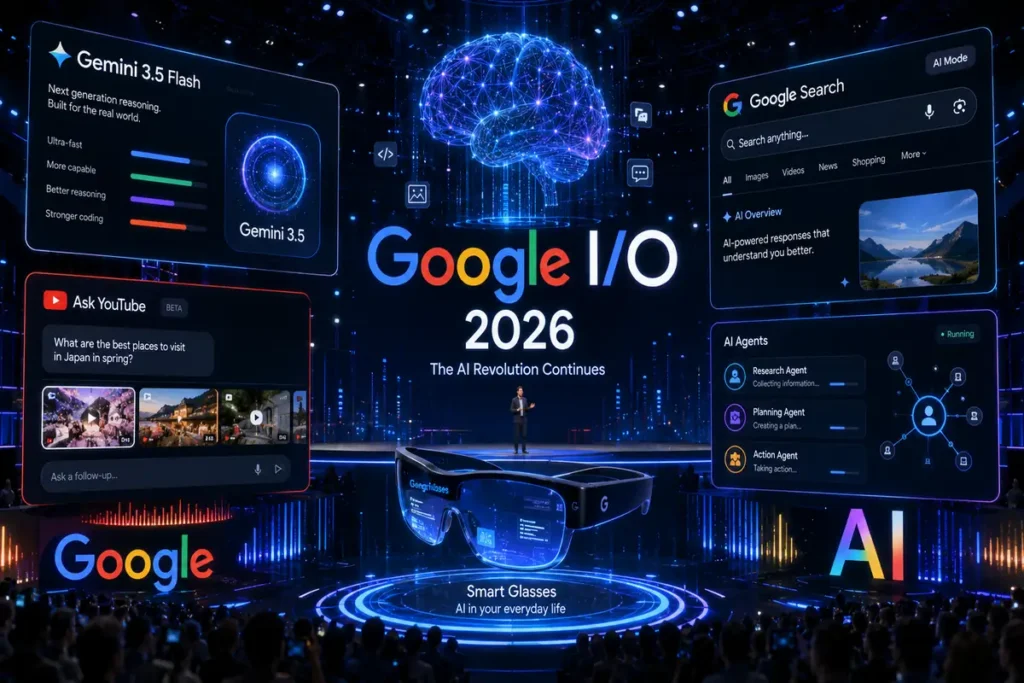
Google has officially placed Artificial Intelligence at the center of its future roadmap. During this year’s Google I/O 2026 developer conference, the company announced a wide range of AI-powered features and products designed to transform how people search, work, create content and interact with technology.
From next-generation Gemini models and conversational YouTube search to AI-powered smart glasses and autonomous AI agents, Google used the event to showcase a future where AI does much more than simply answer questions. Instead, the company is aiming to create intelligent assistants capable of understanding users, completing tasks and working in the background across multiple platforms.
The keynote made one thing very clear: Google wants AI to become a deeply integrated part of everyday digital life.
Google I/O Massive AI Expansion
Artificial Intelligence was the central focus throughout the event. Google highlighted the rapid growth of its AI ecosystem and revealed that adoption of Gemini and AI-powered products continues to rise globally.
The company emphasized that millions of users are already relying on AI-powered experiences across Search, productivity tools and creative applications. As AI usage continues to increase, Google now wants to move beyond traditional assistants and introduce AI agents capable of handling more complex and personalized tasks.
Instead of users manually switching between apps, typing prompts or searching repeatedly, Google’s long-term vision appears to involve AI systems that can understand context, anticipate needs and take actions automatically. That vision shaped nearly every announcement during the conference.
Ask YouTube Introduces a More Human Way to Search
One of the standout announcements from the event was Ask YouTube. Traditionally, users search YouTube by entering simple keywords such as “fitness tips” or “best travel destinations.” While effective, that method often requires users to refine searches multiple times before finding the right content.
Google is now changing that process. With Ask YouTube, users can search using natural conversations instead of isolated keywords. Users can ask longer questions, provide context and continue asking follow-up questions without restarting the search process. For example, someone could search :
“Show me beginner home workout videos.”
Then continue with:
“Now only show workouts without equipment.”
Or ask:
“Give me meal ideas for muscle building.”
Followed by:
“Show vegetarian options under 500 calories.”
Google says the feature searches across YouTube’s complete content library, including long-form videos and Shorts, before presenting a structured response. The goal is to make YouTube feel less like a video archive and more like an intelligent assistant capable of understanding user intent.
Docs Live Brings Voice-Powered Content Creation
Google also introduced Docs Live, a feature designed to simplify document creation. Previously, users interacting with AI often had to carefully write detailed prompts in order to generate useful content. Google believes that process can sometimes feel unnatural, especially for users unfamiliar with prompt writing.
More Read

Docs Live aims to solve that problem. Instead of typing instructions, users can simply speak naturally while AI listens and automatically converts spoken ideas into a structured document. Someone brainstorming ideas for a presentation, article or meeting notes could simply talk while Gemini organizes thoughts into a clean document format.
This feature could significantly improve productivity for students, professionals and creators by reducing friction between ideas and execution.
Gemini Omni Expands AI Beyond Text
Google also introduced Gemini Omni, a major step toward more advanced AI systems. Unlike earlier AI models that mainly focused on text, Gemini Omni can process multiple types of information simultaneously.
These include :
- Text
- Images
- Audio
- Video
Google says Gemini Omni Flash combines reasoning abilities with content generation features. The company demonstrated how the system could accept various forms of input and generate editable content grounded in real-world understanding.
Rather than treating images, videos and speech separately, Gemini Omni aims to understand all these inputs together in a more human-like way. This could potentially lead to more natural AI experiences and improved content creation workflows.
Gemini 3.5 Flash Becomes Google’s New AI Model
Another major announcement during the event was Gemini 3.5 Flash. Google says the new model delivers improvements over previous versions in multiple areas, especially coding and practical real-world tasks.
According to the company, Gemini 3.5 Flash offers :
- Better reasoning abilities
- Improved coding performance
- Faster responses
- Enhanced problem solving
- Stronger real-world usefulness
The company confirmed that the model is now being integrated into the Gemini app and AI-powered Search experiences. Gemini 3.5 Flash is expected to power many of Google’s upcoming AI products moving forward.
Antigravity 2.0 Pushes AI Agents Forward
Google also expanded its AI agent ecosystem with the launch of Antigravity 2.0. The earlier version of Antigravity focused largely on coding environments. However, the new version expands into broader AI coordination. Google describes it as a central hub where multiple autonomous AI agents can work together.
For example, one AI agent could gather information while another organizes data and another performs specific actions. The system represents Google’s broader ambition to create AI workflows involving teams of intelligent agents rather than isolated tools.
Gemini Spark Brings Personal AI Assistance
Another important announcement was Gemini Spark. Integrated directly into the Gemini app, Spark is designed to work as a personal AI assistant capable of handling long and complex tasks in the background. Rather than responding only after receiving instructions, Spark can continue working over time.
Potential tasks include :
- Organizing schedules
- Managing reminders
- Summarizing information
- Completing repetitive workflows
- Handling planning tasks
This announcement signals Google’s growing interest in AI systems that proactively assist users.
Search Is Becoming More Than Search
Search received some of the conference’s largest updates. Google announced several AI improvements that aim to transform Search into an intelligent assistant rather than a traditional search engine.
Users will soon be able to search using multiple input formats including:
- Text
- Images
- Videos
- Files
- Browser tabs
Google also introduced information agents capable of continuously searching and taking actions in the background. Users can continue conversations directly from AI-generated responses instead of repeatedly entering new searches. This approach could significantly change how people interact with online information.
Google Returns to Smart Glasses
Google also confirmed its return to wearable technology with new AI-powered smart glasses. The company revealed plans for two different versions:
Audio Glasses: These provide spoken assistance directly through audio interactions.
Display Glasses: These display visual information directly in front of users.
Unlike previous smart glass attempts, Google is now combining wearable technology with advanced AI capabilities. The move suggests Google sees AI assistants eventually extending beyond smartphones and laptops into everyday wearable devices.
Google I/O 2026 may ultimately be remembered as one of Google’s biggest AI-focused events ever. From Gemini 3.5 and conversational YouTube search to AI agents and smart glasses, the company presented a future where AI becomes deeply woven into daily digital experiences.
Rather than simply answering questions, Google’s AI strategy now appears focused on building systems that understand, assist and complete tasks independently.
As AI technology continues evolving, Google’s announcements suggest that the next generation of computing may revolve less around apps and more around intelligent assistants working seamlessly in the background.