

Microsoft might have stepped away from the smartphone race after discontinuing its Android-powered Surface Duo series, but the tech giant isn’t throwing in the towel just yet.
A newly uncovered patent application filed with the United States Patent and Trademark Office (USPTO) reveals that Microsoft is quietly engineering a revolutionary foldable mobile device. Aimed directly at capturing market share from Apple’s iPhone and top-tier Android flagships, this new design targets the two biggest pain points of current folding devices: the prominent screen crease and device thickness.
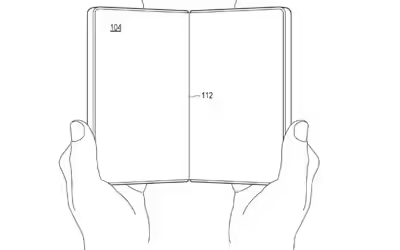
Instead of the dual-screen form factor that failed to gain mainstream traction with the Surface Duo 2, Microsoft is pivoting toward a single, continuous flexible display utilizing a highly advanced mechanical design called the “Spine Cover Plate.”
What is Microsoft’s ‘Spine Cover Plate’ Technology ?
According to the official patent documentation, Microsoft’s next-generation smartphone features a book-style folding design, closely resembling the form factor of Samsung’s Galaxy Z Fold series. However, the true innovation lies hidden within its central spine.
Standard foldable devices rely on rigid, static hinge covers that often leave micro-gaps when closed. Microsoft’s patented Spine Cover Plate is a dynamic, moving component linked directly to the internal gear assembly.
Key Technical Improvements Over Current Foldables:
- Zero-Gap Dust and Water Resistance: The spine cover automatically adjusts its position during the opening and closing transitions. By shifting in real-time, it completely seals the structural elements, preventing pocket lint, dust, and water droplets from migrating under the flexible substrate.
- Crease Elimination: The floating architecture of the mechanism allows the flexible display to bend at a highly optimized, uniform curvature radius, making the display crease significantly less visible to the naked eye compared to existing options on the market.
- Ultra-Thin Form Factor: When folded, the spine plate actively retracts inward toward the central axis. This reduces the dead space inside the hinge, drastically reducing the overall width and thickness of the chassis for comfortable, one-handed usability.
Also read : Moto G54 Price Cut in India : Powerful 5G Smartphone Now Available at a Lower Price
Can Microsoft Overcome the Practicality Dilemma ?
While the engineering blueprint presents an elegant solution on paper, the smartphone industry has a complicated history with mechanical complexity.
Currently, premium manufacturers use a “water-drop” hinge system to minimize screen wrinkling. Microsoft’s strategy introduces a shifting external plate controlled by miniature guide pins, internal grooves, and opposing tension springs.
The Durability Risk: In consumer tech, more moving parts generally mean more potential points of mechanical failure. Adding an adjusting secondary cover over an already intricate folding hinge could impact long-term drop resistance, even if it solves the immediate issues of water ingress and screen creases.
Will the ‘Surface Fold’ Ever See a Commercial Launch ?
It is crucial to remember that a patent filing is an exploration of intellectual property, not a guarantee of an immediate product launch. Following structural reorganization and the high-profile departure of former Surface chief Panos Panay, Microsoft has focused its recent hardware efforts heavily on its traditional PC portfolio, such as the Surface Laptop and dual-screen productivity devices.
However, this patent proves that Microsoft’s mobile R&D pipeline is still actively solving complex smartphone problems. If the company successfully refines the practicality of this single-screen “Spine Cover” mechanism, it could provide the definitive hardware edge needed to challenge Apple and Google’s market dominance.