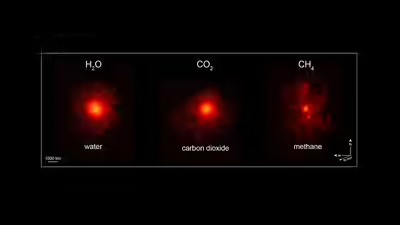



The universe has once again surprised astronomers with a mysterious visitor from deep space. Known as Interstellar Comet 3I/ATLAS, this extraordinary object has captured global attention not only because it originated outside our Solar System but also because new research suggests it may be around 7 billion years old-significantly older than the Sun itself.
Since its discovery in July 2025, 3I/ATLAS has been at the center of scientific debates, including controversial claims that it could potentially be an alien technological artifact. While most astronomers reject the alien hypothesis and favor a natural explanation, recent findings indicate that this comet may still be one of the most remarkable objects ever observed.
If confirmed, 3I/ATLAS could provide scientists with a rare glimpse into the conditions that existed billions of years before our Solar System was born.
Also read : Is Wood Rarer Than Diamonds ? The Mind-Blowing Cosmic Truth Revealed
Discovery of Interstellar Comet 3I/ATLAS
The comet was first detected on July 1, 2025, by the ATLAS (Asteroid Terrestrial-impact Last Alert System) survey telescope located in Chile.
What made the discovery immediately exciting was its trajectory. Scientists quickly determined that the object was not gravitationally bound to the Sun, meaning it originated from another star system and was simply passing through our cosmic neighborhood.
This made 3I/ATLAS only the third confirmed interstellar object ever discovered, following:
- ‘Oumuamua (2017)
- 2I/Borisov (2019)
- 3I/ATLAS (2025)
Each of these visitors has provided valuable insights into planetary systems beyond our own, but 3I/ATLAS may be the most significant of them all.
Why Some Scientists Considered an Alien Origin
Shortly after the comet’s discovery, Harvard astrophysicist Avi Loeb and his collaborators published a paper exploring whether the object might be more than just a naturally occurring comet.
Their argument was not that 3I/ATLAS was definitely alien technology. Instead, they suggested that several unusual characteristics made it worthy of further investigation.
Among the features they highlighted were:
- An unusually high speed
- A steep entry angle into the Solar System
- A unique trajectory near several planets
- The possibility of unexplained behavior near perihelion
Loeb’s team proposed that these characteristics were unusual enough to keep open the possibility that the object could be a technological artifact rather than a simple comet.
One of the most discussed ideas in the paper was the suggestion that 3I/ATLAS could potentially fit into a “Dark Forest” interpretation of the Fermi Paradox, where advanced civilizations remain hidden and cautious about revealing themselves.
The researchers even speculated that the object might function similarly to an interstellar probe, though they emphasized that this was merely a hypothesis rather than evidence.
These claims generated widespread media attention and fueled public imagination. However, the overwhelming majority of astronomers continued to support a natural explanation for the object’s origin.
Oxford Researchers Reveal a More Extraordinary Possibility
While discussions about alien origins attracted headlines, a new study from researchers at the University of Oxford may have uncovered something even more fascinating.
Astronomer Matthew Hopkins, working alongside Professor Chris Lintott and researchers from the University of Canterbury in New Zealand, developed a new system known as the Ōtautahi-Oxford Model.
This model analyzes the trajectories of interstellar objects to estimate:
- Their likely origin
- Their galactic history
- Their possible age
When the team applied the model to 3I/ATLAS, the results were astonishing.
According to their analysis, there is roughly a two-thirds probability that the comet is older than our Solar System.
The model’s best estimate places the object’s age at approximately 7 billion years, making it potentially the oldest comet ever observed by humanity.
Older Than the Sun Itself
To understand how remarkable this finding is, it helps to compare the ages involved.
- Earth: approximately 4.5 billion years old
- Sun: approximately 4.6 billion years old
- Solar System: approximately 4.6 billion years old
- Estimated age of 3I/ATLAS: approximately 7 billion years old
If these estimates are correct, the comet formed billions of years before our Sun even existed.
That means this icy traveler may have witnessed a large portion of our galaxy’s history before the Solar System was ever created.
In cosmic terms, 3I/ATLAS could be considered a true relic from an ancient era of the Milky Way.
A Visitor From the Milky Way’s Thick Disk
One of the strongest clues regarding the comet’s age comes from its unusual path through the galaxy.
Most stars, including our Sun, belong to a region known as the thin disk of the Milky Way.
However, astronomers believe that 3I/ATLAS likely originated from the galaxy’s thick disk, a much older stellar population located above and below the thin disk.
The thick disk contains stars that are believed to be:
- Around 10 to 12 billion years old
- Rich in ancient galactic material
- Among the earliest generations of stars in the Milky Way
Because 3I/ATLAS entered the Solar System at a steep angle consistent with objects from this region, researchers believe it likely formed around one of these ancient stars.
This strengthens the possibility that the comet truly predates our Solar System by billions of years.
Why 3I/ATLAS Matters to Science
Comets are often described as cosmic time capsules.
Unlike planets, which undergo geological changes over billions of years, comets preserve much of the original material from the environments in which they formed.
Scientists believe that 3I/ATLAS contains ancient ice, dust, and volatile compounds that have remained relatively unchanged for billions of years.
Studying these materials could help researchers understand:
Ancient Planet Formation
The comet may reveal how planets formed around stars much older than the Sun.
Galactic Evolution
Its composition could provide clues about conditions in the Milky Way during its early history.
Chemical Building Blocks of Life
Scientists are particularly interested in determining whether the comet contains organic molecules that may have played a role in the development of life elsewhere in the universe.
Interstellar Object Diversity
Comparing 3I/ATLAS with previous interstellar visitors may help researchers understand how planetary systems differ throughout the galaxy.
Is the 7-Billion-Year Age Confirmed ?
Not yet.Astronomers emphasize that the estimated age of 7 billion years is not a direct measurement.
Unlike rocks on Earth, which can be dated through radioactive analysis, scientists cannot physically collect samples from 3I/ATLAS.
Instead, the estimate comes from sophisticated statistical modeling based on:
- Orbital characteristics
- Galactic motion
- Probable region of origin
Future observations and improved models may refine these estimates.
Even if the exact age changes, researchers remain confident that the object is likely far older than most comets observed within our Solar System.
More Interstellar Visitors Are Coming
The discovery of 3I/ATLAS may only be the beginning.
Before 2017, no confirmed interstellar object had ever been detected. Today, astronomers have already identified three.
With the launch of the powerful Vera C. Rubin Observatory in Chile, scientists expect discoveries to accelerate dramatically.
Researchers believe the observatory could detect multiple interstellar objects every year.
Each new visitor will provide valuable data about distant star systems and help scientists test theories about how planetary systems form and evolve across the Milky Way.
Whether or not it turns out to be exactly 7 billion years old, Interstellar Comet 3I/ATLAS is already one of the most fascinating objects ever observed.
The comet has sparked debates about alien technology, challenged our understanding of interstellar visitors, and offered a rare opportunity to study material that may have formed billions of years before our Solar System existed.
As it continues its journey back into interstellar space, astronomers around the world will keep analyzing the data collected during its brief visit. The answers hidden within this ancient cosmic traveler may reshape our understanding of the galaxy and our place within it.