


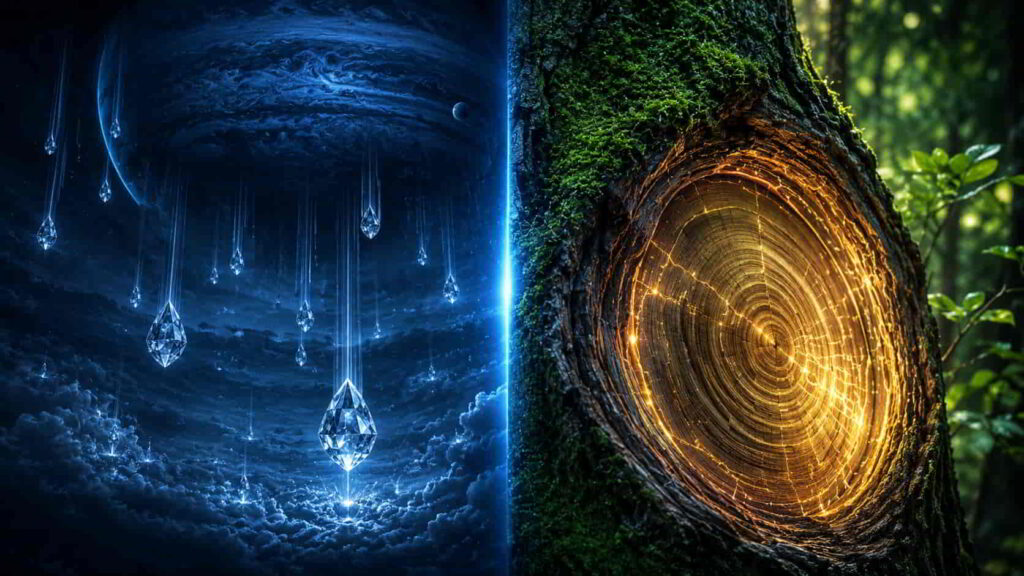
Is Wood Rarer Than Diamonds ?
For centuries, humanity has treated diamonds as the ultimate symbol of rarity and value. We mine deep into the Earth, pay premium prices, and guard them with high-tech security. But from a cosmic perspective, science tells a completely different story.
If you were to board a spacecraft and travel to the outer edges of our solar system, you would find that the universe is actually incredibly efficient at making diamonds. Wood, on the other hand, is a different story entirely. You won’t find it in planetary atmospheres, drifting through nebulae, or buried inside asteroids.
New scientific insights are changing how we define “rare,” proving that every tree in your local park is made of a material far scarcer than the most flawless gemstone in existence.
The Cosmic Diamond Factory: No Life Required
Carbon is one of the most flexible elements in chemistry. Under the right conditions, it easily rearranges its atoms into graphite, fullerenes, or diamonds. The universe doesn’t need to work hard to create these conditions-it just needs raw physics.
Inside ice giants like Uranus and Neptune, intense atmospheric pressure squeezes carbon compounds, breaking their molecular bonds and reorganizing them into crystalline structures. Scientists have modeled this phenomenon for decades in planetary simulations, supported by data from NASA’s Voyager flybys.
Also read :Did Neanderthals Have a Language ? New Research Could Change What We Know About Human Evolution
The Planetary Diamond Formation Process
| Step | Phase / Condition | What Happens Inside Ice Giants |
| 1. The Raw Material | Methane Gas | Planets like Uranus and Neptune contain massive amounts of methane in their atmospheres. |
| 2. The Catalyst | Extreme Pressure & Heat | Deep inside the planet, crushing pressures and high temperatures break the chemical bonds of methane, freeing carbon atoms. |
| 3. The Final Outcome | Diamond Rain | The isolated carbon atoms crystallize into diamonds, sinking through the atmosphere like a planetary gemstone rain. |
Even interstellar space is filled with them. Deep-space telescopes studying interstellar dust clouds have picked up signatures of nanodiamonds-tiny carbon crystals suspended between stars, formed by the explosive energy of supernovas. When meteorites land on Earth, they frequently carry these ancient cosmic diamonds. The takeaway is simple: diamonds are the natural outcome of pressure, temperature, and time. Biology is not required.
Wood: Chemistry Organized by Biology
Wood does not form under tectonic compression or stellar heat. It cannot be created by thermodynamics alone. Wood is a highly complex material that can only exist through a sustained, living metabolism.
At its core, wood is built from two complex polymers:
- Cellulose: Long, intricate chains of glucose produced when a tree captures sunlight, carbon dioxide, and water during photosynthesis.
- Lignin: An organic polymer that fills the gaps between cellulose chains, providing the rigid structural strength that allows trees to grow tall.
More Read
This process requires a massive, synchronized biological machine. A plant must maintain a vascular transport system to move water from its roots, manage specific enzymatic pathways to construct polymers, and adapt to seasonal cycles.
Without this precise biological machinery, wood simply cannot exist. In the universe, carbon is abundant-but the life required to organize it into wood is not.
The “Rarity” Misconception
The idea that wood is rarer than diamonds gained viral traction following insights shared by molecular biologist and science communicator Hashem Al-Ghaili. However, popular science often oversimplifies the comparison. Comparing diamonds to wood is not a fair match because they belong to two completely different categories of matter:
Cosmic Material Comparison
| Material | Primary Creation Driver | Cosmological Status |
| Diamond | Pure Physics & Thermodynamics (Pressure/Heat) | Common (Found on planets, meteorites, and space dust) |
| Wood | Advanced Biology & Evolution (Metabolism/Photosynthesis) | Ultra-Rare (Confirmed only on Earth) |
People often point to organic molecules and amino acids found in space-such as those discovered inside the famous Murchison meteorite that fell in Australia in 1969-as proof that complex carbon is out there. But those molecules only indicate that prebiotic chemistry can happen in a vacuum. Wood requires an entirely different level of organization: sustained energy flow, reproduction, compartmentalization, and millions of years of evolutionary history.
What This Tells Us About the Search for Alien Life
This shift in perspective completely changes how astrobiologists look at the cosmos. Finding diamonds, gold, or complex crystals on an alien planet tells us almost nothing about whether that planet can support life. It just tells us about the planet’s geology and atmospheric pressure.
But finding a material like wood-a structured, layered, growth-based carbon architecture shaped entirely by metabolism—would be the ultimate proof of complex extraterrestrial biology.
For now, Earth remains the only confirmed system where the chaotic physics of the universe have converged into forests. Every single tree ring on our planet is doing something the rest of the cosmos cannot do: recording the passage of time through the mechanics of life.